


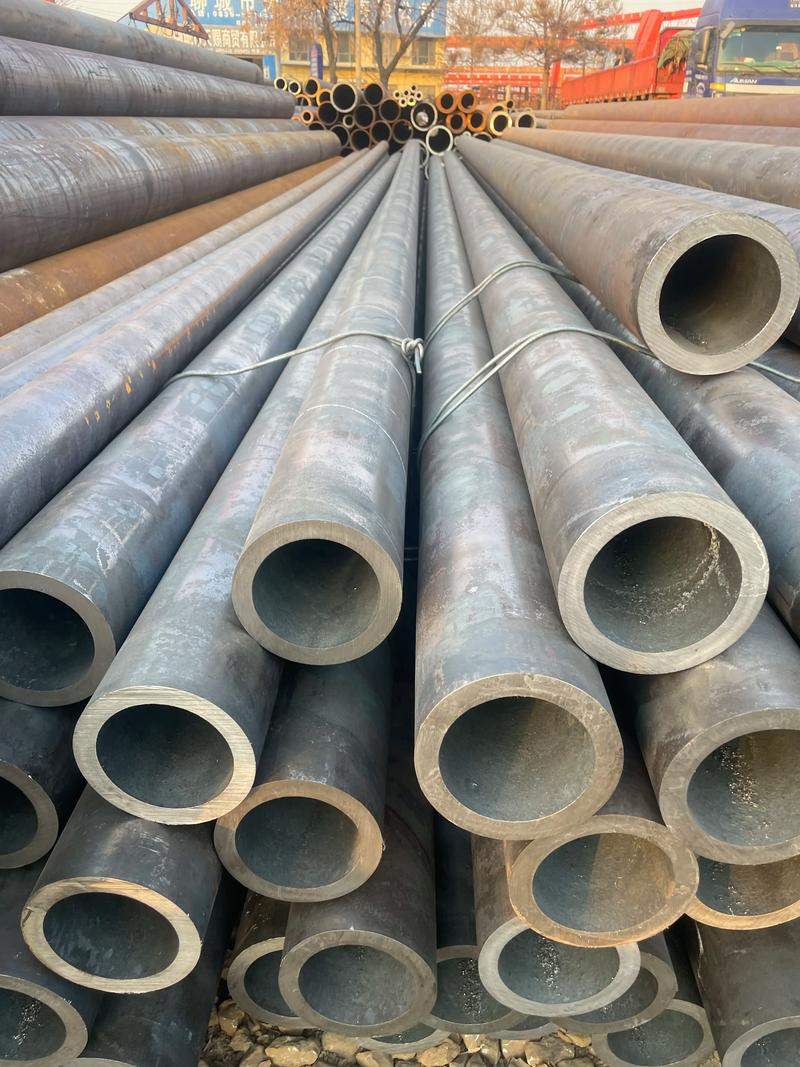
Product introduction
ASTM A1040 is a medium-carbon steel widely used in structural and machinery applications due to its balanced properties.
| Element | Composition Range (wt%) | Role in Steel |
|---|---|---|
| Carbon (C) | 0.37 - 0.44 | Primary hardening element; increases strength & hardness |
| Manganese (Mn) | 0.60 - 1.00 | Enhances hardenability & strength |
| Phosphorus (P) | ≤ 0.040 | Residual element (impurity) |
| Sulfur (S) | ≤ 0.050 | Improves machinability but can reduce toughness |
| Iron (Fe) | Balance (~98%) | Base metal |
(Diagram suggestion: Pie chart showing composition percentages)
The microstructure of ASTM A1040 varies significantly with heat treatment:
As-Normalized Microstructure:
Ferrite + Pearlite (lamellar structure)

As-Quenched & Tempered (Typical Condition):
Tempered Martensite (fine carbide particles in ferrite matrix)
Microstructural Features:
Pearlite: Provides strength & moderate ductility
Ferrite: Enhances ductility & toughness
Tempered Martensite: Optimal balance of strength & toughness
(Diagram suggestion: Micrographs comparing normalized vs. quenched & tempered structures)
| Property | Normalized Condition | Quenched & Tempered | Unit |
|---|---|---|---|
| Yield Strength (σ_y) | 350 - 450 | 550 - 700 | MPa |
| Tensile Strength (σ_u) | 550 - 700 | 700 - 900 | MPa |
| Elongation at Break | 18 - 22 | 15 - 18 | % |
| Reduction in Area | 40 - 50 | 45 - 55 | % |
| Hardness (Brinell) | 170 - 210 | 200 - 270 | HB |
| Impact Energy (Charpy V-notch) | 20 - 30 | 25 - 40 | J @ 20°C |
(Diagram suggestion: Bar chart comparing strength values in different conditions)
Characteristic Curve:
         Ultimate Tensile Strength (UTS)
            ↑
            |       /\
            |      /  \
            |     /    \
Stress (σ)  |    /      \
            |   /         \______ → Fracture
            |  /
            | / Yield Point
            |/
            +----------------------→
                     Strain (ε)
Key Features:
Elastic Region: Linear relationship (obeys Hooke's Law)
Yield Point: ~350-700 MPa depending on heat treatment
Strain Hardening: Significant work hardening capability
Ductile Fracture: Typical cup-and-cone fracture morphology
The hardness of ASTM A1040 shows excellent depth consistency when properly heat treated:
Surface Hardness: 200-270 HB
Core Hardness: 190-260 HB
Hardness vs. Tempering Temperature Relationship:
Higher tempering temperatures → Lower hardness, higher toughness
Optimal tempering range: 400-600°C for most applications
(Diagram suggestion: Graph showing hardness vs. tempering temperature)
ASTM A1040 exhibits an excellent strength-ductility combination:
High Strength Applications:
- Quenched & tempered condition
- Strength: 700-900 MPa
- Good fatigue resistance

High Ductility Applications:
- Annealed or normalized condition
- Better formability & machinability
Fatigue Limit: ~250-350 MPa (for 10⁷ cycles, polished specimen)
Notch Sensitivity: Moderate (benefits from compressive residual stresses)
Moderate wear resistance suitable for gears, shafts
Can be improved through surface hardening (induction/carburizing)
Based on Mechanical Properties:
High Strength Components: Axles, crankshafts, connecting rods
General Machinery: Gears, bolts, studs, spindles
Structural Elements: High-strength fasteners, brackets
Automotive: Transmission components, steering parts
Heat Treatment           →  Resulting Properties
─────────────────────────────────────────────────
Normalizing (870°C)      →  Good machinability, moderate strength
Quenching (850°C, water/oil) + Tempering (400-600°C)
                         →  High strength with good toughness
Annealing                →  Maximum softness for machining
| Property | ASTM A1040 | AISI 1035 | AISI 1045 |
|---|---|---|---|
| Carbon Content | Medium (0.37-0.44%) | Lower (0.32-0.38%) | Higher (0.43-0.50%) |
| Strength | Balanced | Lower | Higher |
| Machinability | Good | Better | Slightly lower |
| Weldability | Fair (preheat required) | Good | Fair |
ASTM A1040 represents an optimal balance in the medium-carbon steel family, offering:
Versatile mechanical properties through heat treatment control
Good manufacturability (machining, forming)
Cost-effectiveness for high-volume applications
Reliable performance in demanding mechanical applications
The steel's properties make it suitable for components requiring high strength with moderate toughness, particularly where cyclic loading is involved.
(Diagram suggestion: Spider chart comparing key properties of A1040 vs. similar steels)
Note: Actual properties may vary based on specific manufacturing process, section size, and heat treatment parameters. Always consult material test certificates for critical applications.
Just like you, 70% customers choose long-term cooperation with BBN steel not only for our good product and service quality, good reputation in the international market, but also for our experienced one-stop raw material supply and further steel processing!
Shandong Chengda Steel Co., Ltd.
 Language

 Online Contact Us


