



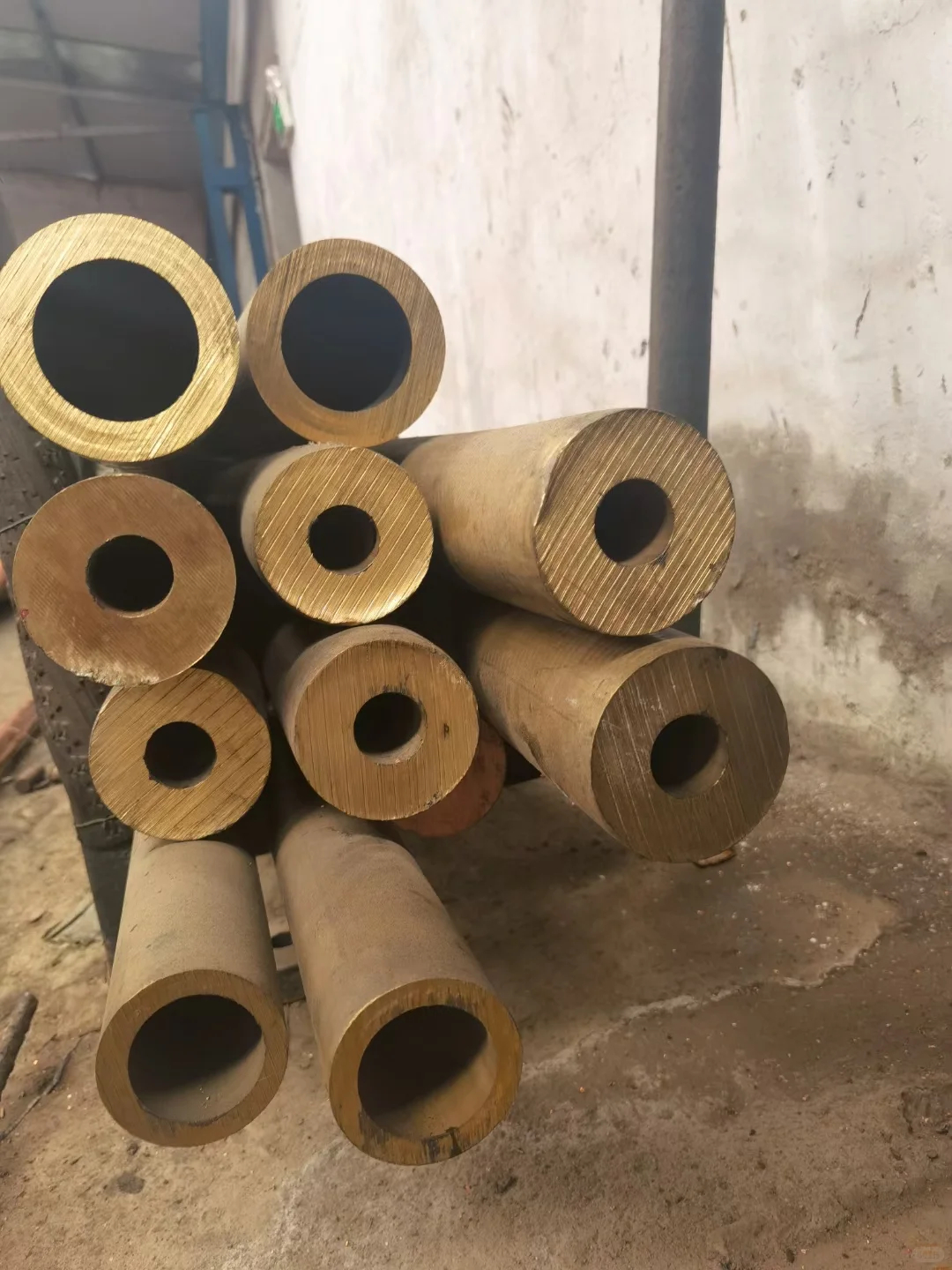
Product introduction
Common Name: H62 Brass
Chinese Standard (GB): H62
Unified Numbering System (Digital Code): T27600
Material Type: Copper-Zinc Alloy / Wrought Brass
H62 is a binary (two-element) brass. Its composition is strictly regulated:
Copper (Cu): 60.5% to 63.5%
This is the main alloying element. The "62" in its name refers to the nominal copper content.
Zinc (Zn): Remainder (approximately 36.5% to 39.5%)
Impurities (Total ≤ 0.5%): Includes elements like Iron (Fe), Lead (Pb), Antimony (Sb), and Bismuth (Bi), which are kept to a minimum to ensure performance.
At room temperature, H62 Brass has a dual-phase structure (α+β').
The α-phase is soft and ductile (like pure copper).
The β'-phase is harder and stronger at room temperature.
This combination of phases gives H62 a good balance of strength and ductility compared to single-phase brasses.
The mechanical properties of H62 are highly dependent on its temper (processing state). It is commonly supplied in various conditions. The values below represent typical ranges:
| Property | Typical Value / Range | Condition Notes |
|---|---|---|
| Tensile Strength | 315 ~ 630 MPa (45,700 ~ 91,400 psi) | Lower values for annealed (soft) state; higher values for cold-worked (hard) state. |
| Yield Strength | 130 ~ 450 MPa (18,900 ~ 65,300 psi) | Significantly increases with cold working (e.g., rolling, drawing). |
| Elongation | ≥10% ~ ≥30% | A measure of ductility. Higher in soft/annealed state, lower in hard/tempered state. |
| Hardness | 89 ~ 180 HV (approx. 50-90 HRB) | Varies greatly with temper. |
| Density | 8.43 ~ 8.5 g/cm³ (0.304 - 0.307 lb/in³) | Constant physical property. |
Good Combination of Strength and Plasticity: Unlike high-zinc brasses that are very brittle, or high-copper brasses that are very soft, H62 offers a useful middle ground.
Excellent Workability: It has good plasticity for cold working (like bending and deep drawing) and also performs well in hot working processes (like forging).
Good Machinability: While not as free-cutting as leaded brasses (like HPb59-1), H62 machines reasonably well for general purposes.
Corrosion Resistance: It has good resistance to corrosion in atmospheric, fresh water, and some chemical environments.
Due to its balanced properties and relatively low cost, H62 is one of the most widely used brass grades. Common applications include:
Fasteners: Nuts, bolts, screws, rivets.
Hardware Components: Gaskets, bushings, washers, pipe fittings.
Radiator Parts: Tanks and pipes for automotive and industrial cooling systems.
General Engineering: Small structural parts, stampings, and deep-drawn items.
Just like you, 70% customers choose long-term cooperation with BBN steel not only for our good product and service quality, good reputation in the international market, but also for our experienced one-stop raw material supply and further steel processing!
Shandong Chengda Steel Co., Ltd.
 Language

 Online Contact Us


