



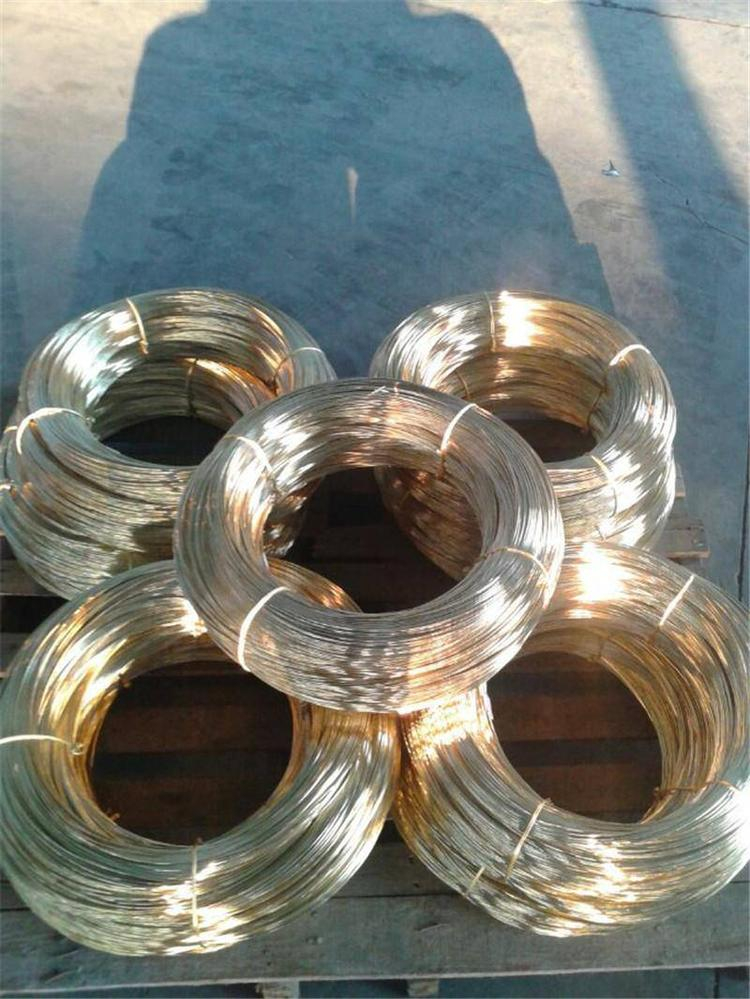
Product introduction
Common Name: H70 Brass
Also Known As: Cartridge Brass or 70/30 Brass (historically used for ammunition casings) .
Chinese Standard (GB): H70 (GB/T 5231-2012, GB/T 2059-2000) .
International Equivalents: C26000 (UNS), C2600 (JIS), ASTM B36/B36M .
Material Type: Wrought Copper-Zinc Alloy / Single-Phase Alpha (α) Brass .
H70 is a high-copper binary brass with a strictly controlled composition to ensure its characteristic ductility .
Microstructure: Due to its high copper content (over 68%), H70 has a single-phase alpha (α) solid solution structure at room temperature . This face-centered cubic structure is inherently soft and ductile, giving H70 the best plasticity among all common brasses .
Density: 8.53 g/cm³
Melting Point: 966 – 1001 °C
Thermal Conductivity: ~140 W/(m·K) (Excellent for heat dissipation)
Electrical Conductivity: ~28-32% IACS (Sufficient for general applications)
Elastic Modulus: ~105 GPa
Like H65, the mechanical properties of H70 vary dramatically with its temper (degree of cold work). It is available in various conditions from soft annealed to spring hard. The values below represent typical ranges:
Note: The table compiles data from multiple technical sources. The exact values depend on the specific product form (sheet, strip, wire) and testing standards. H70's key advantage is its ability to achieve a wide range of strengths while maintaining excellent formability in softer tempers .
Best Formability: H70 possesses the highest plasticity and cold workability of all common brass grades, making it the top choice for the most challenging deep-drawing and bending operations .
Excellent Strength-Ductility Balance: It offers a unique combination of high strength (when work-hardened) and exceptional ductility (when annealed), unmatched by lower-copper brasses .
Good Joinability: It has excellent solderability (soft soldering and brazing) and good weldability (with argon protection) .
Corrosion Resistance: Provides good resistance to atmospheric corrosion, fresh water, and some chemicals . However, it is susceptible to stress corrosion cracking (season cracking) if internal stresses from cold working are not relieved by annealing .
H70 is the material of choice for parts requiring severe cold forming .
Ammunition: Cartridge cases (its historical and most famous application) .
Automotive: Radiator cores and tanks, heat exchanger components, cooling system parts .
Industrial: Deep-drawn parts,波纹管 (bellows), flexible hoses, pump components, gaskets .
Hardware & Electronics: Connectors, terminals, fasteners, springs, eyelets, rivets, zippers .
You asked about H65 earlier. Here is a quick comparison to highlight the differences:
| Feature | H70 Brass | H65 Brass |
|---|---|---|
| Cu Content | 68.5-71.5% (Higher) | 63.0-68.5% (Lower) |
| Microstructure | Single-phase α | Single-phase α (at higher Cu end) |
| Key Strength | Best plasticity & formability | Excellent formability, slightly higher strength potential in hard tempers |
| Typical Use | Most severe deep drawing (e.g., cases) | Deep drawing + general parts (e.g., terminals) |
In short, H70 is the specialist for ultimate formability, while H65 offers a slightly more balanced and cost-effective option for a wider range of applications.
If you have a specific application in mind (e.g., deep drawing a complex shape), I can help you decide between H70 and H65.
Just like you, 70% customers choose long-term cooperation with BBN steel not only for our good product and service quality, good reputation in the international market, but also for our experienced one-stop raw material supply and further steel processing!
Shandong Chengda Steel Co., Ltd.

 Language

 Online Contact Us


